
-
- Shop Collections
- Shop by Goal
- Shop by Health Need
- Shop By Brand


Item added to your cart


Tests Heavy Metals & Essential Elements
Parts-Per-Trillion Accuracy & Sensitivity
At-Home Heavy Metal Exposure Testing
 Fast Delivery
 Easy Returns
 Manage Subscriptions Anytime
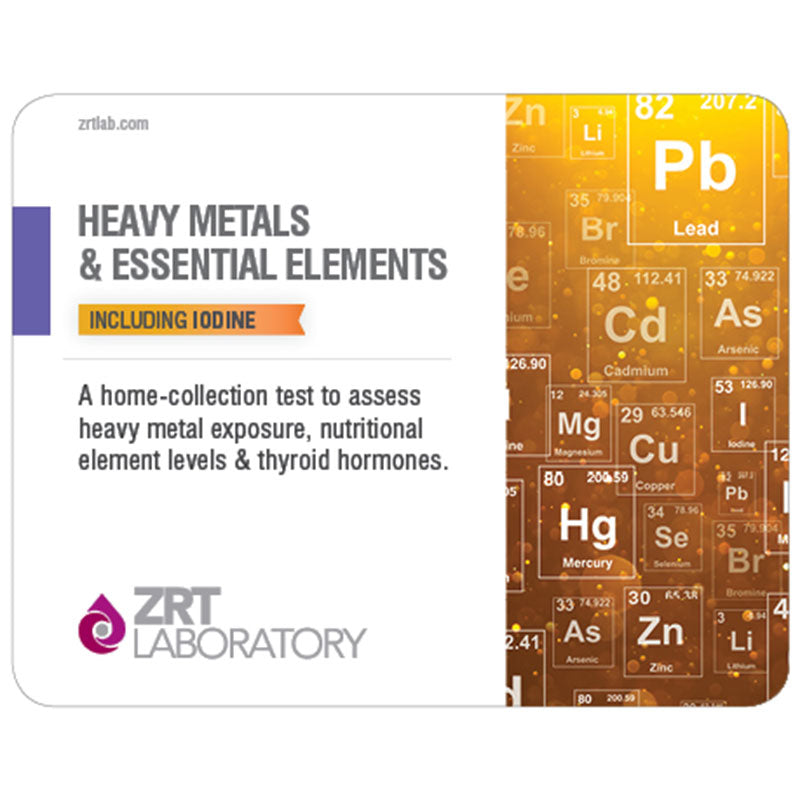
This at-home kit screens both toxic heavy metals and nutritionally essential elements. ZRT Laboratory analyzes the samples by ICP-MS and reports whether each element sits inside or outside its expected range.
| Laboratory | ZRT Laboratory |
| Toxic elements | Arsenic, mercury, cadmium |
| Essential elements | Iodine, selenium, zinc, copper, magnesium, plus bromine and lithium |
| Method | ICP-MS |
| Collection | At home. Your kit insert lists the exact samples and elements included. |
| Results | About 2 weeks |
Most heavy metals tests only look for the bad ones. This one looks at both, and the reason is that they interact.
Arsenic, mercury and cadmium have no known nutritional role in the body. ZRT notes that they are the top three on the CDC's priority list of hazardous substances, and that mercury and cadmium accumulate and are retained, so exposure adds up over a lifetime.
Essential elements are different. Iodine, selenium, zinc, copper and magnesium are only useful within a range. Too little causes problems and too much causes problems.
The two groups are linked. ZRT describes toxic elements forming tight bonds with essential elements such as selenium, reducing how much of it is available to the enzymes that depend on it. And bromine, which sits in the same chemical family as iodine, competes with iodine, which becomes more of an issue when iodine is already borderline low. So a heavy metal reading is more interpretable when you can see the essential elements next to it.
Not a technicality. It changes what you can find.
Arsenic is measured only in urine. It clears from the bloodstream quickly after exposure, so a blood test would only catch it if you tested immediately afterward. Urine is the clinically useful route.
Magnesium is measured in dried blood spot rather than serum. ZRT's explanation is that the body holds serum magnesium in a tight range at the expense of intracellular stores, so a serum magnesium test reads normal in most people even when they are short. Dried blood spot includes intracellular magnesium.
Copper and zinc are also measured in dried blood spot, which ZRT says reflects intracellular as well as serum levels and can reveal a shortfall earlier than a standard serum test.
Dried blood spot. A momentary finger stick and a few drops of blood on filter paper.
Dried urine. Collected onto filter strips that you dip or urinate onto and then hang to dry. ZRT has published research showing the dried urine method is comparable to a full 24-hour liquid collection.
Everything goes in the box and into regular mail with prepaid shipping. No refrigeration required. Your kit insert gives the exact number of samples and the timing.
A wellness and monitoring tool, not a diagnostic test, and not a replacement for evaluation by your physician. It does not diagnose any condition and it is not an assessment of acute poisoning. If you believe you have had a significant exposure, contact your doctor or Poison Control rather than ordering a kit.
An element result is only useful if it changes something. Flourish has pharmacists and nutrition professionals who can look at your report next to what you are already taking, which for mineral supplementation is usually the whole question.
Your results are delivered to you and to the Flourish pharmacy team. An optional review with a Flourish pharmacist or nutritionist is available. No appointment is required to receive your results and there is no obligation.
What does a heavy metals test measure?
Toxic elements including arsenic, mercury and cadmium, alongside nutritionally essential elements including iodine, selenium, zinc, copper and magnesium, plus bromine and lithium. Your kit insert lists exactly which elements are included in your profile.
Can you test for heavy metals at home?
Yes. Collection is done at home with a finger-stick blood spot and dried urine on filter strips, with prepaid shipping to ZRT Laboratory.
Why is arsenic only in the urine portion?
Arsenic clears from the bloodstream rapidly after exposure. A blood test would only detect it if taken almost immediately, so urine is the useful measurement.
Is a dried blood spot magnesium test better than serum magnesium?
They measure different things. ZRT's position is that serum magnesium is held in a tight range by the body, so it often reads normal even when intracellular magnesium is low. Dried blood spot includes the intracellular fraction.
What is ICP-MS?
Inductively Coupled Plasma Mass Spectrometry, the analytical method ZRT uses for elements.
How long do results take?
About two weeks after the laboratory receives your samples.
Will this tell me if I have heavy metal poisoning?
No. It is a wellness screening that shows whether elements fall inside or outside their expected ranges. It does not diagnose poisoning or any other condition. If you have had a significant known exposure, that is a call to your doctor, not a mail-in kit.
Should I test before or after taking a mineral supplement?
Either can make sense depending on your question. Call 405-751-3333 and tell us what you are taking.
A Flourish pharmacist will read them together. Contact the Flourish team or call 405-751-3333. You can also browse our at-home test kits.
Based on testing performed by ZRT Laboratory.
The Food and Drug Administration has not evaluated these statements. Flourish-supported products are not intended to diagnose, treat, cure or prevent any disease. If you are pregnant, nursing, taking medication, or have a medical condition, consult your physician before using this product.
